
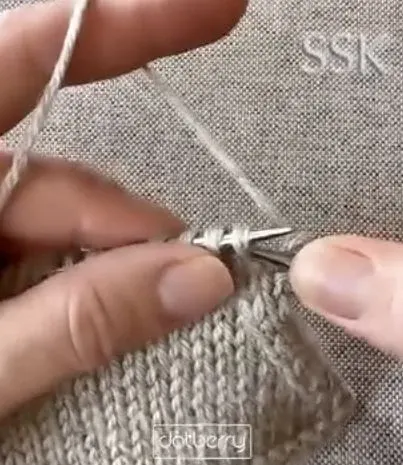
How do Eastern and Continental knitting differ? The difference is in how you work knit and purl stitches and how the stitches are mounted on the needle. Purl stitches are mounted the same way in both methods, but you work them differently. Knit stitches differ both in how they’re mounted and in how you work them.
The goal is the same: you can knit the same project and get the same result with either method. The way you work the stitches is what changes.
Two methods, different notation
Patterns written for Continental knitting use familiar abbreviations such as k2tog (knit two together) for a right-leaning decrease and ssk (slip, slip, knit) for a left-leaning decrease. They keep instructions concise and clear for knitters who use English-language terminology.
Eastern knitting doesn't have an equally widespread set of abbreviations. In my patterns I describe the result we want, such as two stitches worked together with a right or left lean. How you work the decrease may differ with each method. The finished decrease still leans the same way.
I want the instructions to be clear and unambiguous whichever way you knit.
One project, two ways to knit it
I write all dotberry patterns for both Continental and Eastern knitters. That’s one of the things I care about most. This applies to the instructions for each part of the project and to the chart key. For each symbol, I explain how to work it in both methods.
You don’t have to change your habits or adapt the way you knit to suit the pattern. Choose a project you like and knit it the way you enjoy.
Which method to start with?
This is my personal opinion, but if you're just learning to knit, I recommend the Eastern method. I find it easier to learn at first, especially for purl stitches.
Continental knitting can be a natural next step. Once you know the basics and understand how stitches behave, it's easier to learn another way to work them.
Every knitter has preferences. Some prefer Eastern knitting and others prefer Continental. Neither method is better or worse. What matters is finding a way that feels comfortable and makes you happy.
See the difference in practice
In my Instagram carousel I show knit and purl stitches and right- and left-leaning decreases, using both methods.
If you’d like to see both techniques step by step, take a look here:
Eastern vs. Continental knitting: See the Instagram carousel
Two methods, one result. Pick yours and knit your way!